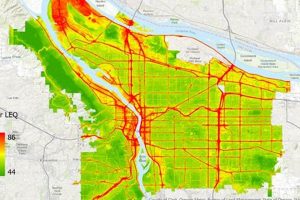
An illustration depicting the probability of seismic activity impacting a specific geographic location, centering on Oregon’s largest city, is crucial for urban planning. This type of depiction commonly employs color-coded scales to represent varying levels of potential ground shaking or structural damage expected from a seismic event. It factors in proximity to fault lines, soil composition, and historical earthquake data.
These assessments are vital for informing building codes, infrastructure development, and emergency preparedness strategies within the metropolitan area. Understanding the spatial distribution of vulnerability allows resources to be allocated effectively, mitigation efforts to be prioritized, and public awareness campaigns to be targeted. Examination of past earthquakes and geologic studies provides the foundation for generating these visualizations and projecting future seismic hazards.
Consequently, the following analysis will examine the geological underpinnings of seismic hazard in the region, detail the methodologies used in creating these spatial representations of risk, and discuss practical applications of these tools for stakeholders ranging from individual homeowners to government agencies.
Mitigating Earthquake Risks in Portland, Oregon
Individuals and organizations within Portland can take proactive steps to minimize the potential impact of seismic events. These guidelines are informed by hazard assessments and best practices in disaster preparedness.
Tip 1: Understand the Regional Geology. Portland’s geological landscape, including the presence of the Portland Hills Fault and underlying soft soils, significantly influences ground motion amplification during an earthquake. Review publicly available geological surveys to assess the specific risks associated with a property’s location.
Tip 2: Retrofit Vulnerable Structures. Pre-1990s buildings, particularly unreinforced masonry structures, are especially susceptible to earthquake damage. Consult with a qualified structural engineer to evaluate the building’s seismic resistance and implement appropriate retrofitting measures, such as bolting the foundation or reinforcing walls.
Tip 3: Secure Interior Furnishings. Falling objects pose a significant risk during seismic activity. Secure bookshelves, cabinets, and other heavy items to walls. Store hazardous materials, such as flammable liquids, in low, secure locations.
Tip 4: Develop a Family Emergency Plan. Establish a communication plan with family members, including designated meeting points and out-of-state contacts. Conduct regular drills to practice earthquake safety procedures, such as drop, cover, and hold on.
Tip 5: Assemble an Emergency Supply Kit. Prepare a kit containing essential supplies, including food, water, medication, a first-aid kit, a flashlight, and a portable radio. Ensure the kit is readily accessible and replenished regularly.
Tip 6: Participate in Community Preparedness Programs. Engage in local earthquake preparedness initiatives, such as Community Emergency Response Team (CERT) training. These programs provide valuable skills and knowledge for responding to disasters.
Tip 7: Review Insurance Coverage. Standard homeowners insurance policies typically do not cover earthquake damage. Consider purchasing separate earthquake insurance to protect against financial losses resulting from seismic events.
Implementing these measures enhances personal and community resilience, contributing to a safer environment in the face of potential earthquake threats. Proactive preparation can significantly reduce the impact of a seismic event on lives and property.
The following sections will delve into specific case studies and advanced mitigation techniques employed in earthquake-prone urban environments.
1. Fault line proximity

The closeness of a location to a fault line is a primary determinant of earthquake risk, and, therefore, a critical component of any risk assessment depiction in Portland. Areas situated directly above or in close proximity to active faults, like the Portland Hills Fault, face a heightened probability of experiencing intense ground shaking during a seismic event. This proximity translates directly to increased potential for structural damage and infrastructure failure. For example, buildings located near the Seattle Fault in Washington State have demonstrably experienced greater damage during historical earthquakes compared to structures further away.
The importance of accurately mapping and understanding fault line locations cannot be overstated. These maps inform building codes, influence land-use planning, and guide the development of emergency response strategies. Structures built closer to identified fault lines often require more stringent seismic design standards to withstand the expected ground motion. Additionally, understanding fault line proximity allows for the identification of areas that may require targeted public awareness campaigns and enhanced disaster preparedness measures.
Failure to account for fault line proximity in risk assessment can lead to significant underestimation of seismic hazard, with potentially devastating consequences. Accurate mapping, coupled with geotechnical investigations to determine site-specific ground response, is essential for creating realistic and effective risk reduction strategies. This data forms a cornerstone of proactive mitigation efforts designed to protect lives and property.
2. Soil liquefaction potential

Soil liquefaction potential constitutes a crucial consideration in assessing seismic risk in Portland, Oregon. This phenomenon, whereby saturated soils lose strength and stiffness in response to earthquake shaking, can significantly amplify the destructive impact of seismic events, particularly in areas with specific geological conditions.
- Role in Amplifying Seismic Damage
Liquefaction can cause ground failure, leading to the tilting and collapse of buildings, the rupture of underground pipelines, and the disruption of transportation infrastructure. The effects of liquefaction were prominently observed during the 1964 Niigata earthquake in Japan, where numerous buildings overturned due to the loss of soil bearing capacity. Areas within Portland with susceptible soil types, such as loose sands and silts along the Willamette River, are particularly vulnerable.
- Impact on Infrastructure Integrity
Critical infrastructure, including bridges, water treatment plants, and emergency response facilities, are at heightened risk in areas prone to liquefaction. The failure of such infrastructure can severely impede rescue and recovery efforts following an earthquake. For example, liquefaction-induced damage to bridges in past earthquakes has resulted in transportation bottlenecks, delaying the delivery of essential aid and hindering evacuation efforts.
- Influence on Building Codes and Land Use Planning
Recognizing liquefaction potential informs building codes and land use planning decisions. Structures built on liquefiable soils require specialized engineering solutions, such as deep foundations or ground improvement techniques, to mitigate the risk of failure. Zoning regulations may restrict development in areas deemed highly susceptible to liquefaction, directing construction to more stable ground.
- Mapping and Assessment Methodologies
The creation of accurate maps depicting liquefaction potential requires detailed geotechnical investigations, including soil borings and laboratory testing to assess soil properties. These investigations are combined with earthquake hazard models to estimate the likelihood of liquefaction occurring at specific locations under different seismic scenarios. The resulting maps are essential tools for guiding mitigation efforts and informing emergency preparedness plans.
The comprehensive evaluation of soil liquefaction potential, and its integration into hazard assessments, is indispensable for creating a realistic and effective strategy for earthquake risk reduction in Portland. Failing to address the vulnerability of liquefiable soils can significantly undermine the resilience of the city and its inhabitants in the face of a major seismic event.
3. Building code adherence

Effective building codes serve as a crucial mechanism for translating the theoretical risks depicted on seismic hazard maps into tangible safeguards against earthquake damage. In Portland, Oregon, strict enforcement of building codes, particularly those pertaining to seismic design, is paramount for mitigating the potential consequences of an earthquake, as revealed by risk depictions.
- Structural Resistance to Ground Motion
Building codes mandate specific engineering standards for the construction and retrofitting of buildings, ensuring their ability to withstand ground motion predicted by the “portland oregon earthquake risk map”. These standards dictate the use of appropriate materials, structural configurations, and connection details to enhance the building’s resilience. For example, buildings in high-risk zones are required to have reinforced foundations and shear walls designed to resist lateral forces.
- Risk-Based Design Requirements
Codes incorporate the probabilistic seismic hazard assessments that underlie earthquake risk maps, tailoring design requirements to the expected level of ground shaking at a specific location. This means that buildings located in areas identified as having higher seismic risk, based on the “portland oregon earthquake risk map”, are subject to more stringent design criteria. This could include a higher seismic design category, requiring more robust structural systems.
- Enforcement and Inspection Processes
Rigorous enforcement of building codes, including thorough plan reviews and on-site inspections, is essential to ensure that structures are built in accordance with the intended seismic design. These processes verify that the construction adheres to the codes and standards, preventing potential deficiencies that could compromise the building’s performance during an earthquake. Regular inspections during construction identify and address any deviations from the approved plans, mitigating the risk of structural failure.
- Retrofitting of Existing Structures
Codes also address the seismic upgrading of existing buildings, especially older structures that were built before the implementation of current seismic standards. Retrofitting programs, informed by risk analyses, aim to improve the seismic performance of these vulnerable buildings, reducing their susceptibility to damage during an earthquake. Examples of retrofitting measures include the addition of shear walls, the strengthening of connections, and the anchoring of unreinforced masonry.
The effectiveness of building codes in reducing earthquake risk is directly linked to their consistent application and rigorous enforcement. Adherence to these codes not only protects individual structures but also contributes to the overall resilience of the community, minimizing the social and economic impacts of a potential seismic event. Continued refinement of building codes, based on the latest scientific understanding of seismic hazards, is crucial for ensuring the safety and well-being of Portland’s residents.
4. Emergency response planning
Effective emergency response planning is inextricably linked to accurate assessments of seismic risk. The “portland oregon earthquake risk map” serves as a foundational tool for developing comprehensive and targeted strategies to mitigate the consequences of a major earthquake.
- Resource Allocation and Staging
The spatial distribution of potential damage, as depicted by the map, informs the strategic allocation of emergency resources. This includes the pre-positioning of medical supplies, search and rescue equipment, and personnel in areas identified as being at high risk. For example, areas with a high probability of liquefaction may require specialized equipment for extricating trapped individuals and stabilizing compromised structures. Resource staging decisions are directly influenced by the projected severity of damage in specific zones.
- Evacuation Route Planning
The map highlights areas vulnerable to landslides, building collapse, and infrastructure failure, which are crucial factors in designing safe and efficient evacuation routes. Routes are planned to avoid these high-risk zones, ensuring that evacuees can reach designated assembly points with minimal exposure to danger. Planning also incorporates considerations for accessibility, catering to the needs of individuals with disabilities and those residing in densely populated areas. Traffic management strategies, derived from the map’s vulnerability assessments, are implemented to prevent bottlenecks and facilitate smooth evacuation flows.
- Communication Network Resilience
The map informs the design of resilient communication networks, ensuring that emergency responders can maintain contact and coordinate effectively during and after an earthquake. Areas with high liquefaction potential may require hardened communication infrastructure to withstand ground deformation. The redundancy of communication systems, including satellite phones and amateur radio networks, is strategically planned to mitigate the risk of disruption due to damage to conventional communication lines.
- Community Preparedness Initiatives
The map is used to tailor community preparedness initiatives to the specific risks faced by different neighborhoods. Public awareness campaigns are targeted to inform residents about the potential hazards in their area, such as liquefaction or landslides, and to educate them on appropriate safety measures. Training programs, such as Community Emergency Response Team (CERT) training, are prioritized in high-risk zones to empower residents to take immediate action and assist their neighbors in the aftermath of an earthquake.
Ultimately, the effectiveness of emergency response hinges on the accuracy and comprehensiveness of the “portland oregon earthquake risk map”. These spatial depictions are not merely academic exercises, but rather vital instruments for safeguarding lives and minimizing the devastation caused by seismic events. Continuous refinement of these analyses, incorporating new data and advanced modeling techniques, is imperative for ensuring that emergency response plans remain relevant and effective.
5. Infrastructure vulnerability assessment

Infrastructure vulnerability assessments are intrinsically linked to seismic risk visualizations for Portland, serving as a critical layer in understanding the potential consequences of an earthquake. The map provides the spatial context for identifying areas where essential infrastructure components bridges, water pipelines, power grids are most susceptible to damage based on soil conditions, fault line proximity, and predicted ground shaking intensity. These assessments examine the structural integrity of these assets, considering age, construction materials, and past performance to predict their likelihood of failure during various seismic scenarios. For example, an older bridge located on liquefiable soil near a known fault line would be flagged as a high-priority concern in such an evaluation.
The process goes beyond simply identifying vulnerable locations; it involves estimating the functional impact of potential failures. A damaged water pipeline could disrupt water supply to hospitals and firefighting services, while a collapsed bridge could isolate communities and impede emergency response efforts. The risk map, combined with infrastructure assessments, allows for the development of mitigation strategies: retrofitting vulnerable bridges, reinforcing critical pipelines, and establishing redundant power sources. Comprehensive evaluation of these vulnerabilities, integrated with the risk map’s spatial data, enhances the resilience of the city’s vital systems. For example, power companies use this type of information to prioritize upgrades of substations in high-risk areas, aiming to prevent widespread blackouts following a seismic event.
In conclusion, the infrastructure vulnerability assessment acts as the applied arm of the risk map, translating potential hazards into tangible implications for essential services. Without this thorough analysis, the risk map alone lacks the specificity needed to guide targeted investments in infrastructure resilience. The continuing interplay between risk assessment and infrastructure evaluation is crucial for enhancing the preparedness and overall safety of Portland in the face of future seismic events. Prioritizing infrastructure upgrades, relocation of services, or the construction of new support structures needs this understanding for proper planning.
Frequently Asked Questions About Seismic Hazard in Portland, Oregon
This section addresses common inquiries regarding the understanding and utilization of seismic hazard assessments in the Portland metropolitan area.
Question 1: What factors contribute to Portland’s earthquake risk?
Proximity to the Cascadia Subduction Zone, local fault lines (such as the Portland Hills Fault), and susceptible soil conditions (including liquefiable soils along the Willamette River) all elevate earthquake risk. The combination of these factors can result in amplified ground shaking and widespread damage during a seismic event.
Question 2: How are these visualizations of risk created?
They are generated by synthesizing data from multiple sources, including geological surveys, historical earthquake records, geotechnical investigations, and advanced computer modeling. Probabilistic seismic hazard analyses (PSHAs) estimate the likelihood of ground shaking exceeding certain thresholds at specific locations over a given time period.
Question 3: What is liquefaction, and how does it impact seismic risk?
Liquefaction occurs when saturated soils lose their strength and stiffness due to earthquake shaking, behaving more like a liquid. This can cause ground failure, leading to the tilting and collapse of buildings, the rupture of underground pipelines, and the disruption of transportation infrastructure. Areas with loose, sandy soils are particularly susceptible.
Question 4: Are all areas of Portland equally at risk from earthquakes?
No. The severity of seismic risk varies depending on factors such as proximity to fault lines, soil type, and building construction. Areas closer to fault lines or with liquefiable soils generally face a higher risk of damage. Building codes also play a crucial role in mitigating risk, with newer structures designed to withstand stronger ground shaking.
Question 5: Can earthquake risk be completely eliminated?
Complete elimination of risk is not possible, but the potential for damage and loss can be significantly reduced through proactive mitigation measures. These measures include retrofitting vulnerable structures, implementing stringent building codes for new construction, developing comprehensive emergency response plans, and promoting community preparedness initiatives.
Question 6: Where can information be found about seismic hazard in a specific Portland neighborhood?
The Oregon Department of Geology and Mineral Industries (DOGAMI) provides extensive resources, including hazard maps, geological surveys, and educational materials. Local city and county planning departments also offer information on seismic risk and building codes in specific areas. Consulting with a qualified geotechnical engineer or structural engineer can provide a more detailed assessment of seismic risk for a particular property.
Understanding the spatial distribution of earthquake hazards is paramount for informed decision-making and effective mitigation strategies. Consulting with qualified professionals and utilizing available resources are crucial steps in enhancing resilience to seismic events.
The subsequent section will explore specific mitigation strategies and technologies employed to reduce seismic vulnerability in urban environments.
Conclusion
This examination has elucidated the critical role of seismic hazard depictions in understanding and mitigating earthquake risk in Portland, Oregon. It has highlighted the geological factors contributing to regional vulnerability, emphasized the importance of integrating these analyses into building codes and emergency response planning, and stressed the need for proactive measures such as infrastructure retrofitting and community preparedness.
Effective mitigation requires continued investment in advanced data collection, modeling techniques, and public education. As scientific understanding of seismic hazards evolves, so too must strategies for reducing vulnerability and enhancing community resilience. The ultimate goal remains to minimize the impact of potential seismic events on lives, property, and critical infrastructure, ensuring the long-term safety and well-being of the metropolitan area.